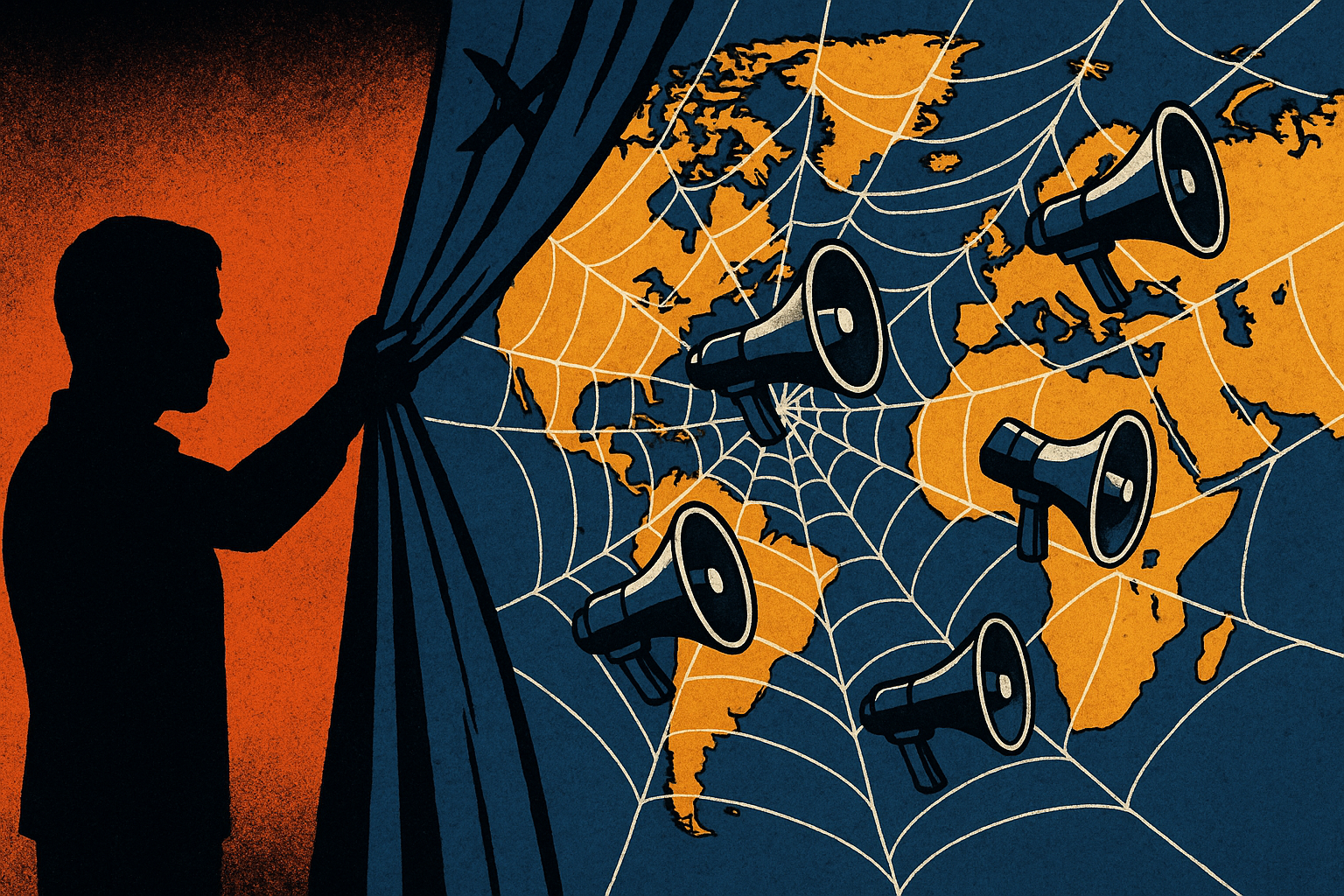
The veil is lifting on X, exposing a global web of propagandists and freelancing grifters - and it's total mayhem out there.
Everyone has been anticipating this for a few days now, but Nikita Bier (head of product at X) finally dropped the bomb: "In a couple of hours, we'll be rolling out About This Account globally, allowing you to see the country or region where an account is based. This will be accessible by tapping the signup date on profiles."
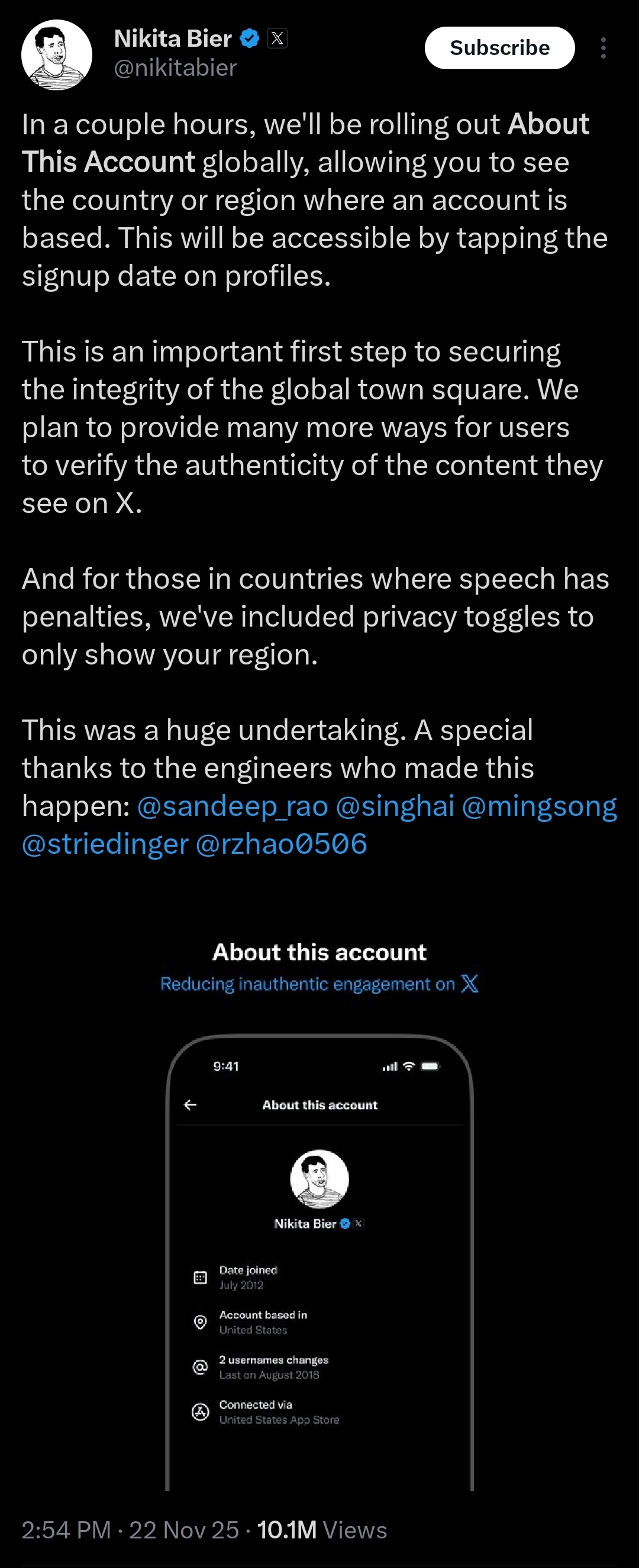
If you've been on X, then you surely cannot escape the many corners with sizable propaganda effect. If anything, we have reached a level of propaganda fatigue I didn't think was possible. Legions upon legions from every ideological persuasion pounced on a list of accounts they taunted or were taunted by. From Ethiopia to India to Thailand to Saudi Arabia to Russia, and around the world you go!
In every corner, there are operatives being exposed. There is an independent journalist here. There is an activist there. There are mercenaries! So many mercenaries! They say this is a public square, but it is a war zone.
The Great Unmasking
Within hours of the rollout, the platform descended into chaos. Users noticed that clicking on an account's join date now opens a tab showing the country or region in which the account is located. Simple enough. Elegant, even. What happened next was anything but.
A prominent account called "MAGA NATION" with over 392k followers turned out to be posting from Eastern Europe, not America. Other examples include "Dark MAGA" based in Thailand, "MAGA Scope" run from Nigeria, and an "America First" account operated from Bangladesh. The irony of "America First" coming from Bangladesh. You can't make this up.
But it's not just the MAGA crowd. The BBC found examples of accounts sharing anti-Trump posts that were actually based outside the US. One account with 52k followers claimed to be a "proud Democrat" and "professional Maga hunter." The user appears to have deleted their profile after it was revealed they were based in Kenya. Everyone is in on the game. Everyone.
This is not about right vs. left. This is about everywhere vs. everyone.
The Iranian Paradox
And then there's Iran, where the feature exposed something far more sinister than mere grifting.
The new feature has exposed accounts in Iran that access the platform using what Iranians call "white SIM cards," which allow unrestricted Internet access as part of the so-called "tiered Internet" system in Iran. In a country where X has been blocked since 2009, most Iranians are forced to use VPNs. But a select few don't need to.
Among those that appear to have unrestricted access to the world wide web are the Fars and Tasnim news agencies, both affiliated with the Islamic Revolutionary Guards Corps (IRGC), as well as several hard-line lawmakers that support restricted Internet access.
The same people advocating for restricted Internet access for ordinary Iranians are posting freely on a platform banned for everyone else. The regime's propagandists don't need VPNs because the regime gave them a pass. Few people in Iran are left feeling good about this.
Some users pushed back, posting screenshots showing X still listed Iran as their connection country even while they said they were using VPNs. The digital-rights group IRCF warned that some widely used circumvention tools can leak signals that leave a user's underlying Iranian connection partly visible.
Iranian activists are being outed via "VPN privilege." A tool meant to expose propagandists is now potentially exposing dissidents. The road to hell, paved with good intentions, etc.
Scotland Is Apparently in Tehran
Just when you thought it couldn't get weirder, enter the Scottish independence movement. Several prominent X accounts posing as supporters of Scottish independence are in fact operated from inside Iran, exposing another layer of the regime's online propaganda machine.
The investigation shows that these accounts, which present themselves as Scottish activists through local imagery, regional vocabulary, and cultural references, were active during the recent 12-day Iran–Israel conflict. For a brief period, they even issued posts supportive of Tehran. When the regime imposed a nationwide internet shutdown during the conflict, all of these accounts went silent at the exact same time.
Why would Iran care about Scottish independence? Why does any foreign influence campaign exist? To exploit weaknesses, in this case, to create chaos.
Each profile changed its username only once at the moment of registration, mirroring a centrally designed template. Their posting rhythms are unusually regular, lacking the natural variability of authentic human users. Their profile pictures are AI-generated. It's all manufactured. An assembly line of fake Scots advocating for breaking up the United Kingdom, run from Tehran with government bandwidth.
The Grift Economy
Let's talk about the mercenaries. Not everyone exposed is a state actor. Many are just hustlers who figured out that rage equals engagement, and engagement equals payment through X's monetization system.
VPN usage doesn't explain accounts with thousands of posts over months, all originating from the same foreign location, all focused on American political rage-bait, all monetizing engagement through Musk's payment system.
This is the grift economy. Some dude in Nigeria figured out that posting "TRUMP 2028! PATRIOTS UNITE!" generates more engagement than whatever else he could be doing. Can you blame him? X created a system where outrage pays, and then acted shocked when people from everywhere showed up to collect.
The account MAGA NATION has not addressed its location and continues to post at a healthy clip. One of its most recent posts asks if its followers think Hillary Clinton should be arrested. Business as usual. The grift doesn't stop just because you got caught.
Vitalik Was Right (Probably)
Vitalik Buterin weighed in, predicting it'll work short-term but state actors will adapt fast, restoring chaos in six months. He's spot on.
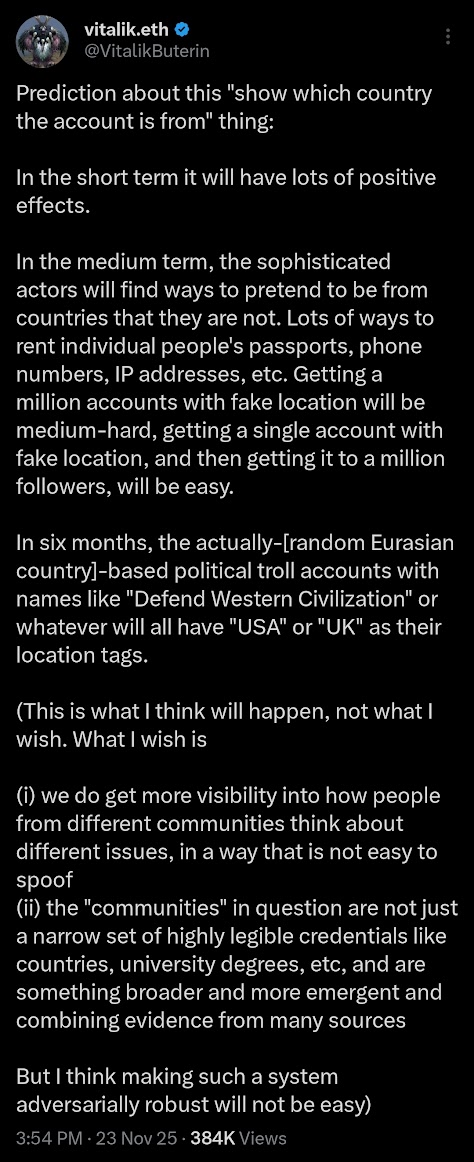
Buterin's critique centers on the feature's vulnerability to manipulation, predicting that within six months, foreign political troll accounts will successfully spoof their locations to appear as though they operate from the United States or the United Kingdom. He argued that creating a single account with a fraudulent location and growing it to a million followers would be straightforward through methods such as renting passports, phone numbers, and IP addresses.
The feature will crush the low-level grift economy. The guy in Bangladesh running "American Patriot 1776" will have to find another hustle. But the professionals? Others say it's an unfair game-ender, because it exposes real locations for honest users, while the most sophisticated bad actors will easily hide behind false ones.
Uniswap founder Hayden Adams called it "psychotic" and questioned its mandatory nature, stating "opt-in doxxing is fine, mandatory doxxing is psychotic." He's not wrong. The crypto community is especially spooked because the feature's implementation appears particularly concerning for crypto users, given the industry's history of targeted attacks and kidnappings related to digital asset holdings.
The Privacy Paradox
The controversy appears particularly stark when contrasted with platform owner Elon Musk's March 2022 statement promising that X would "do whatever it takes to protect the rights of users to remain anonymous, as they would otherwise face persecution from employers or risk of physical harm."
So which is it? Anonymity for those who need it, or transparency for the public square?
X allows users to adjust whether or not the feature displays their country or if it only displays their geographical region. Originally, the company had said this would be an option in areas where free speech could have penalties. But that creates its own problem. If you're choosing to hide your country, you're essentially signaling you have something to hide.
Buterin warned that even a small amount of location data could expose high-risk users to real-world harm, especially high-worth crypto holders or individuals living under restrictive governments.
The same feature protecting Americans from foreign propaganda is potentially exposing Iranian dissidents to the regime.
Virtual Walls for a Virtual World
Maybe we do need buffers - virtual walls like De-Propagandized Zones (DPZs). Imagine geofencing your feed to your own region or country. A "Local Only" mode may just help turn down the temperature.
I'm half-joking. But only half.
The thing is, we spent decades celebrating the borderless internet. Information wants to be free! The global village! Turns out the global village has a lot of people who want to burn down your specific house.
This immediate impact is a jolt of awareness, because both the public and policymakers can now see concrete examples of how outsiders try to shape American political conversations from afar. This awareness is a double-edged sword though. On one hand, it empowers users to identify foreign propaganda. On the other hand, it injects a new layer of skepticism into political discourse - people may reflexively dismiss opposing views as "just foreign bots."
Which is exactly what will happen. Every argument will now end with "show me your location." Lose an argument? "You're a bot from Pakistan." It's going to be insufferable.
Where Do We Go From Here?
The fallout of this update is going to take a few weeks to fully sink in. But here's what I think happens:
The freelance grifters? They're toast and back to the pros we go. Maybe.
The state actors? Buterin argues that while obtaining fake locations for a million accounts might prove moderately difficult, creating a single account with a fraudulent location and growing it to a million followers would be straightforward. They'll adapt. They always do.
And for the rest of us? We'll spend the next six months checking everyone's location details before engaging in any argument, only to realize that the tag doesn't really prove anything because VPNs exist and sophisticated actors have already adapted.
It is unclear how this experiment will play out, and I think it will take a good 6-12 months for us to fully realize its impact. One can't help shake the feeling that we are erecting virtual walls in a clear rebuke to the globalization of the public square.
The internet was supposed to connect us all, but manipulation at scale is turning out to be unsustainable.
And that, is a problem that location tags cannot solve.