The $5 Billion Problem Hiding in Plain Sight #
TikTok Live has quietly become one of the largest peer-to-peer value transfer systems in the world. In 2024, TikTok's virtual gifting economy exceeded $5 billion in transactions globally. Users purchase virtual coins with real money, send animated gifts to live streamers, and those streamers convert the resulting "diamonds" into cash deposits to their bank accounts.
On its surface, this is a creator economy success story. Millions of content creators earn a living through their audiences' generosity. But underneath the dancing and lip-syncing, a different kind of transaction is happening. Criminal organizations have discovered that TikTok Live gifts offer something traditional banking does not: a way to move money across borders with minimal identity verification, no transaction limits on the sending side, and virtually no regulatory oversight.
This is not theoretical. Law enforcement agencies across multiple countries have identified TikTok Live as a growing vector for money laundering, with investigations uncovering coordinated gifting rings that move hundreds of thousands of dollars through the platform each month.
How the Diamond Pipeline Works #
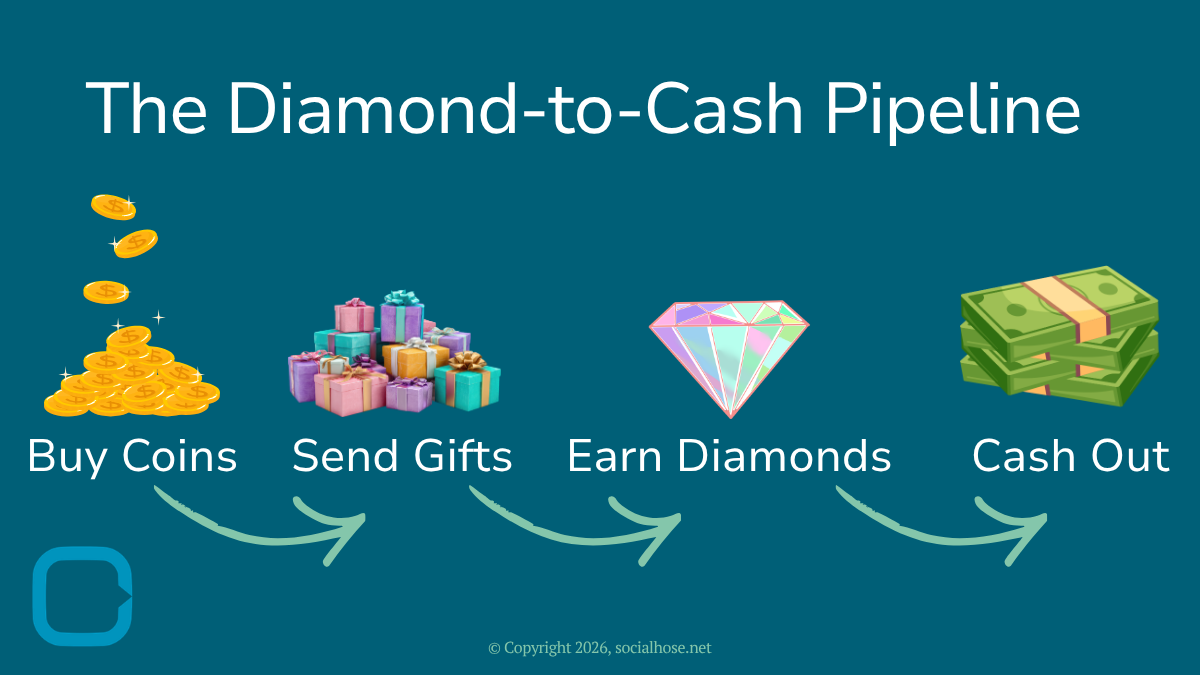
To understand why TikTok Live is attractive to launderers, you need to understand the money flow. It works in four steps.
First, a user purchases TikTok coins using a credit card, debit card, or mobile payment. TikTok does not require identity verification for purchases below certain thresholds, and even above those thresholds, the verification requirements vary by jurisdiction. This is the on-ramp where dirty money enters the system.
Second, the user joins a live stream and sends gifts to the broadcaster. Each gift has a fixed diamond value. A "Rose" costs 1 coin, while a "Universe" costs 34,999 coins. The gifts are visible to everyone watching the stream, but the volume and speed of a busy live session makes individual transactions effectively invisible to casual observers.
Third, the broadcaster accumulates diamonds. At a conversion rate of roughly 200 diamonds to $1 USD, a single live session can generate thousands of dollars in diamond value. The broadcaster can see who sent what, but there is no built-in mechanism for TikTok to flag unusual patterns in real time.
Fourth, the broadcaster withdraws the cash equivalent to their linked bank account. At this point, the money has been converted from potentially illicit funds into what appears to be legitimate creator income. The paper trail, such as it is, shows a series of "gifts" from "fans", not the coordinated transfers they actually represent.
Five Patterns That Signal Laundering Activity #
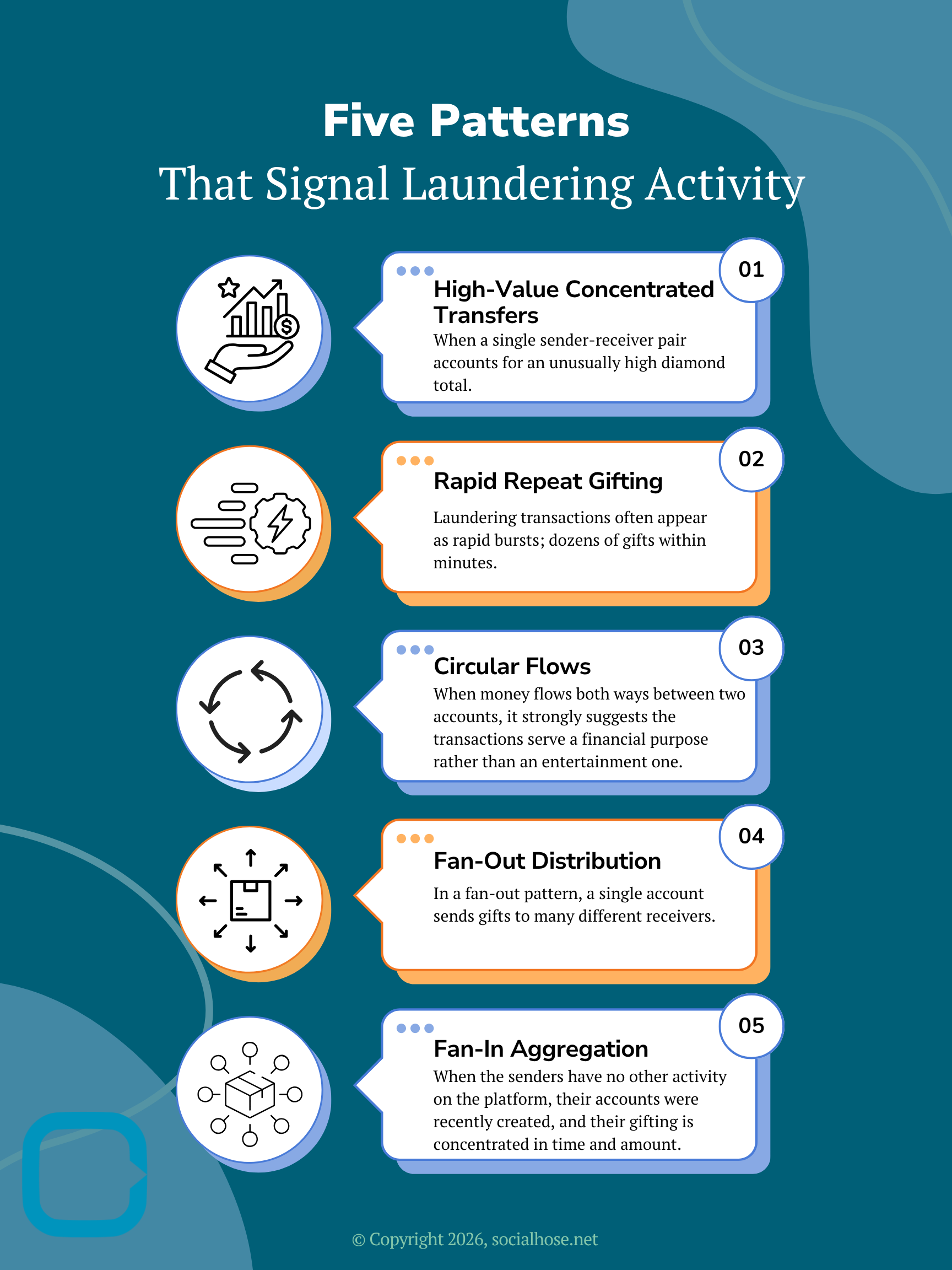
Not every large gift is suspicious, and not every frequent gifter is a criminal. The challenge for investigators is separating legitimate creator-fan relationships from coordinated financial schemes. Through analysis of gift transaction networks, five distinct patterns consistently emerge in confirmed laundering cases.
1. High-Value Concentrated Transfers #
Legitimate fans typically send a mix of small and medium gifts over time. Laundering operations tend to involve large, concentrated transfers - thousands of dollars worth of diamonds in a single session or across a short period. When a single sender-receiver pair accounts for an unusually high diamond total, it warrants investigation. The dollar amount alone is not the indicator; it is the concentration relative to the account's normal activity.
2. Rapid Repeat Gifting #
Normal gifting behavior is sporadic. A viewer watches for a while, sends a gift when something entertaining happens, maybe sends another later. Laundering transactions often appear as rapid bursts; dozens of gifts within minutes, sometimes using the same gift type repeatedly. This pattern suggests the gifting is not driven by entertainment value but by a need to transfer a specific amount quickly.
3. Circular Flows #
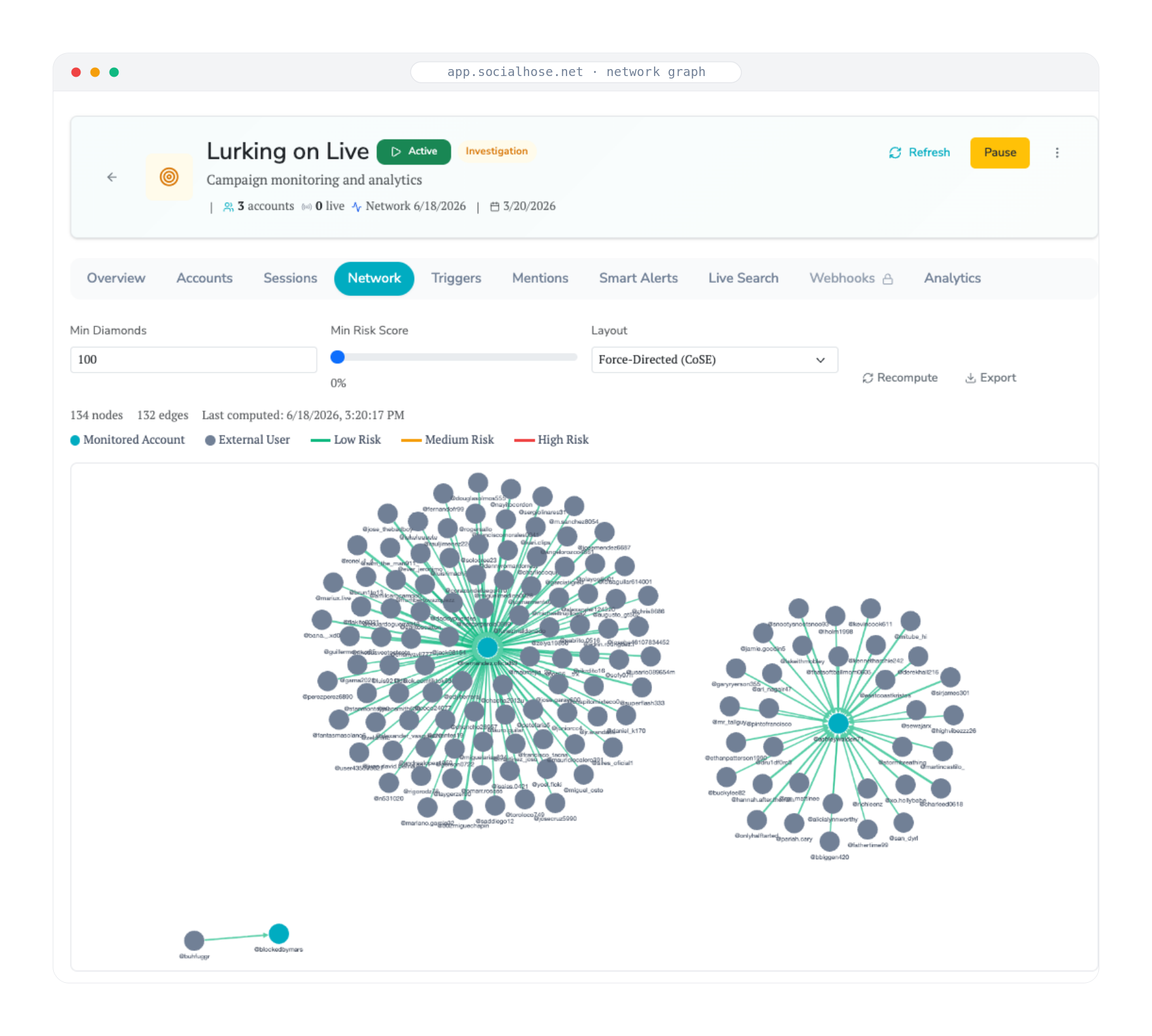
This is the most telling indicator. In a circular flow, Account A sends gifts to Account B during one live session, and Account B sends gifts back to Account A during another. Legitimate fan-creator relationships are almost never bidirectional. When money flows both ways between two accounts, it strongly suggests the transactions serve a financial purpose rather than an entertainment one. The funds are being shuffled to obscure their origin.
4. Fan-Out Distribution #
In a fan-out pattern, a single account sends gifts to many different receivers. On its own, this could be a generous viewer. But when the amounts are large, the timing is concentrated, and the receivers are otherwise unrelated accounts, it indicates fund dispersal. That is, breaking a large sum into smaller pieces distributed across multiple cash-out points.
5. Fan-In Aggregation #
The inverse of fan-out: many different senders all gifting to a single receiver. Again, popular creators naturally receive gifts from many fans. The red flag is when the senders have no other activity on the platform, their accounts were recently created, and their gifting is concentrated in time and amount. This pattern indicates fund collection, many sources feeding into a single aggregation point for withdrawal.
Why Traditional AML Tools Miss This #
Existing anti-money laundering infrastructure was built for traditional financial institutions. Transaction monitoring systems watch bank transfers, wire payments, and card transactions. They look for structuring, smurfing, and unusual cross-border flows within the banking system.
TikTok Live operates entirely outside this infrastructure. The money enters through consumer payment rails (app store purchases, credit cards) that appear as ordinary consumer spending. It exits through creator payouts that appear as legitimate earnings. The laundering happens in the middle, in a layer that no traditional AML system monitors.
Even platforms that monitor social media for brand mentions or sentiment analysis are not equipped for this. They track keywords, hashtags, and post content. They do not capture the financial metadata of live stream gift transactions in real time. The gift data is not public; it requires active connection to live streams as they happen.
Network Analysis: The Key to Detection #
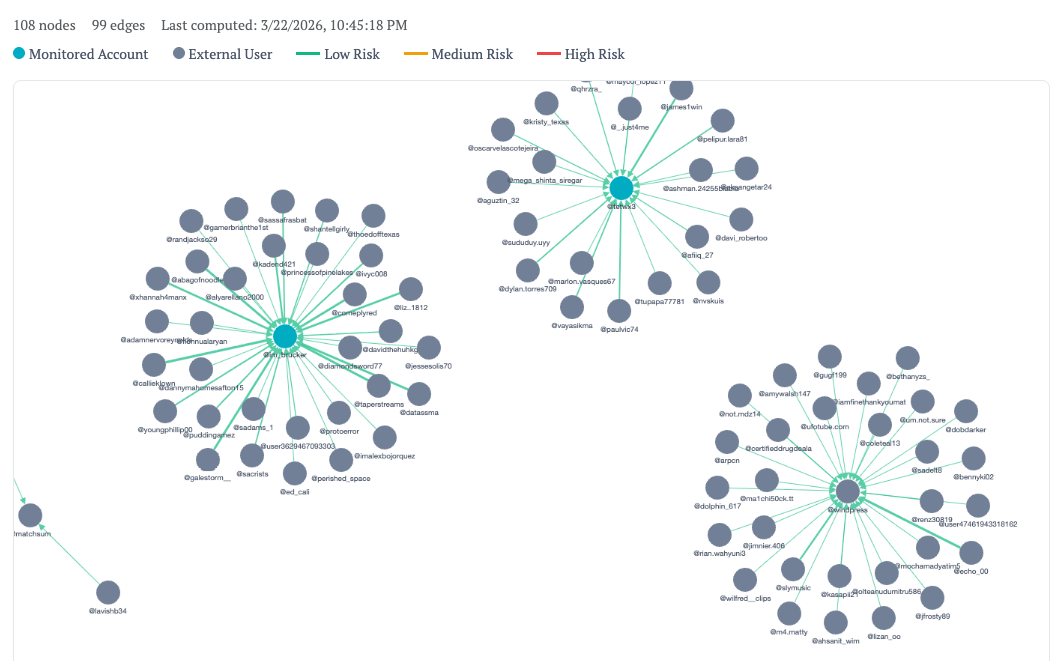
The most effective approach to identifying laundering on TikTok Live is network analysis. Rather than looking at individual transactions in isolation, network analysis maps the relationships between all participants across all sessions and looks for structural patterns.
In a network graph, each TikTok user becomes a node, and each gift flow between two users becomes an edge. The edge carries metadata: total diamond value, number of transactions, time span, and the number of sessions in which the flow occurred. When you visualize an entire investigation's worth of gift data this way, the patterns described above become immediately visible.
Circular flows appear as bidirectional edges. Fan-out patterns appear as a single node with many outgoing edges. Fan-in patterns appear as a single node with many incoming edges. High-value concentrated transfers appear as thick, heavily weighted edges. Automated risk scoring can then flag the highest-risk relationships for investigator review, dramatically reducing the manual effort required to find actionable leads in large datasets.
This approach scales in ways that manual review cannot. An investigator watching a live stream can only observe one session at a time and cannot easily cross-reference gifting patterns across multiple accounts and sessions. Network analysis aggregates everything automatically and surfaces the most suspicious relationships first.
What Investigators and Compliance Teams Should Do Now #
The creator economy is not going away, and neither is the potential for its misuse. For law enforcement, compliance professionals, and regulatory bodies, the time to develop TikTok Live monitoring capabilities is now, before the laundering techniques become more sophisticated and harder to detect.
Start by understanding the scope. If your investigations or compliance program touches cross-border money movement, online fraud, or digital payment platforms, TikTok Live should be on your radar. The volumes are already significant, and they are growing.
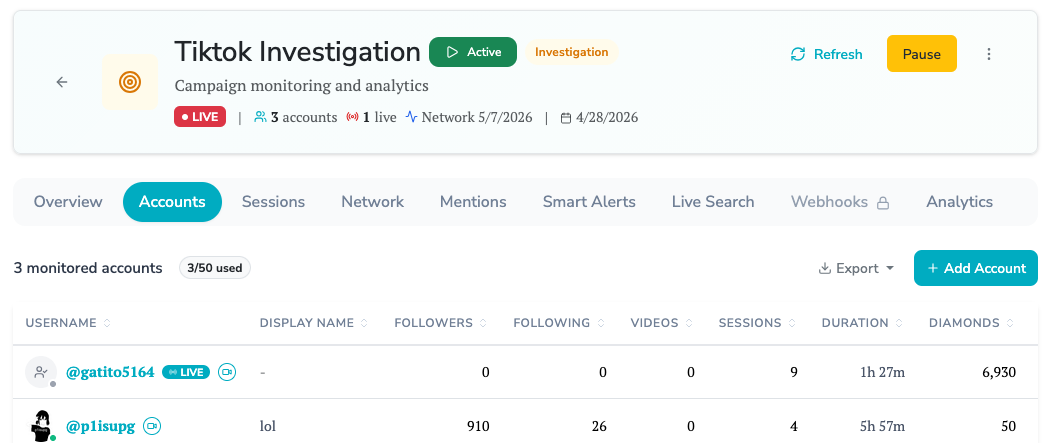
Invest in tooling that can capture gift transaction data in real time. Manual monitoring of live streams is not viable at scale. You need automated systems that detect when target accounts go live, connect to the stream, record every gift and chat event, and aggregate the data into analyzable formats.
Adopt network analysis methodologies. Individual transaction review will not uncover the structural patterns that define laundering operations. Graph-based analysis that maps sender-receiver relationships across time and sessions is essential for detecting the circular, fan-out, and fan-in patterns that characterize coordinated schemes.
Build risk scoring into your workflow. With potentially thousands of gift transactions per investigation, manual prioritization is impractical. Automated risk indicators that flag the highest-risk relationships allow investigators to focus their time where it matters most.
Closing the Blind Spot #
TikTok Live's gifting system represents a genuine blind spot in the current anti-money laundering landscape. The platform was not designed for financial crime, but its mechanics - anonymous value transfer, cross-border reach, and minimal oversight - make it an attractive channel for those seeking to move money outside regulated systems.
The good news is that the same data that enables laundering also enables detection. Gift transactions leave a digital trail. Network patterns are mathematically identifiable. Risk scoring can be automated. The tools and techniques exist to close this gap.
At Socialhose, we have built TikTok Live investigation tools specifically for this purpose. 24/7 account monitoring, real-time gift and chat capture, automated network graph analysis, and multi-dimensional risk scoring. If your team is looking to add TikTok Live to your investigative capabilities, we would welcome the conversation.
The laundering is happening now. The question is whether your team has the visibility to see it.