When Gift Counts Don't Tell the Whole Story #
Investigators monitoring TikTok Live for money-laundering patterns have always faced the same blind spot. The platform produces a torrent of structured data (gifts, diamonds, viewer counts, chat messages) but those events don't capture what was actually said, shown, or coordinated on screen. A 50,000-diamond gift burst from one account to another tells you a transfer happened. It doesn't tell you what the broadcaster was doing in the seconds before, what verbal cues triggered the burst, or whether the same on-screen gestures appear across different sessions and different broadcasters.
We just shipped TikTok Live stream recording: full HD video and audio capture of live sessions, persisted to durable storage alongside the existing event monitoring pipeline. Investigators can now correlate every gift transaction with the visual and audio context it occurred in, and revisit sessions weeks or months later for case review.
What Stream Recording Captures #
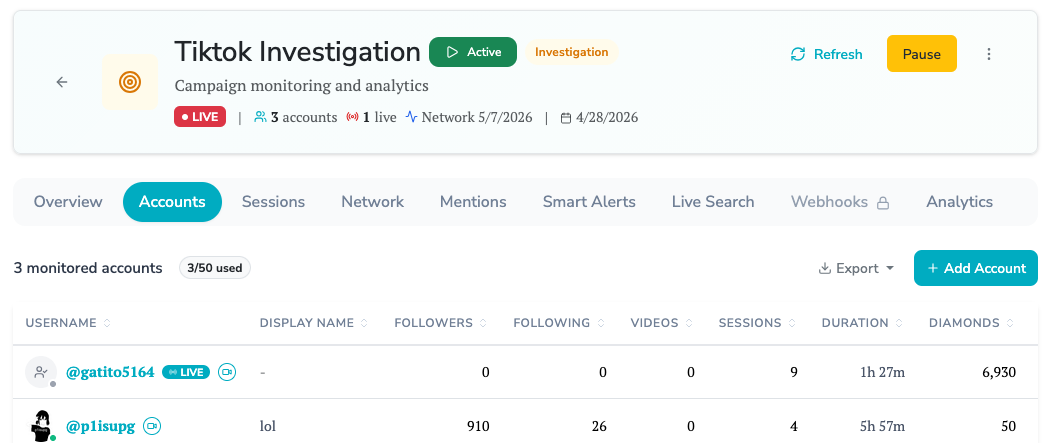
Stream Recording runs alongside the existing event monitor with no overlap or interference. While the monitor logs gift senders, diamond values, chat messages, and viewer counts in real time, the recorder pulls the actual broadcast feed (h264 video, AAC audio) through a dedicated proxy and writes it to durable storage in 8 MB chunks as the stream progresses.
Every recording is HD quality by default. Per-session duration caps are set by plan tier (4 hours on Investigator Pro, 12 hours on Investigator Agency) so even marathon broadcasts are captured in full. If a stream drops mid-session and the broadcaster reconnects, the recorder transparently re-resolves the new URL and continues writing to the same file rather than starting a new one.
Per-Account Opt-In #
Recording is selective. Investigators flip recording on per monitored account from the Account Detail page, leaving social-graph satellites on event-only monitoring. This matters for two reasons.
Signal-to-noise. Most accounts in a typical investigation are peripheral. They are source nodes whose gifting patterns you want to map, but whose individual broadcasts add nothing to the case file. Recording them wastes storage and analyst attention.
Cost control. Recording is metered separately from event monitoring (more on that below), and per-account opt-in keeps the meter under direct investigator control.
When a recording-enabled account goes live, dispatch happens automatically. There is no manual step to start the recorder. The same live detection that triggers event monitoring also kicks off the recording task.
What This Unlocks for Investigators #
A handful of use cases drove this feature out of beta.
Evidence preservation #
TikTok Live broadcasts are ephemeral. Once a session ends, the video is gone forever. Replays are creator-controlled and rare. For an investigator building a case file, the only proof a broadcast happened at all is the event log. Stream recording makes that proof visual and auditable: a captured MP4 file with synchronized audio, alongside the event ledger that timestamps every gift and chat message against the same wall clock.
Verbal cue analysis #
A pattern that has emerged across financial-crime investigations is verbal cuing. The broadcaster says or signals something on stream that triggers a coordinated gift burst from senders waiting for the prompt. This is invisible in the event log alone. With audio capture, investigators can map verbal cues to gift bursts and separate scripted laundering operations from organic broadcasts.
Cross-session pattern matching #
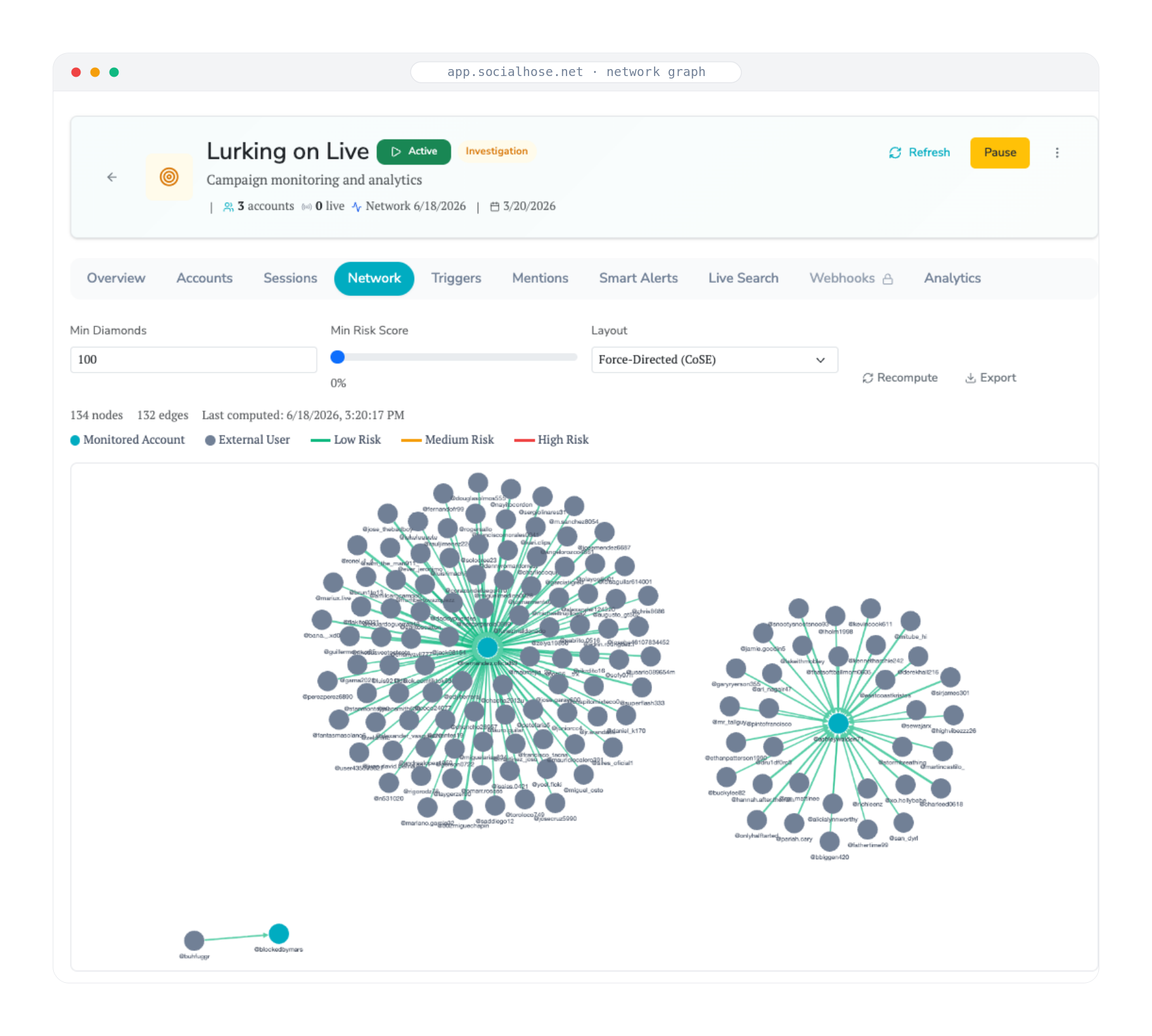
Once you have a corpus of recorded sessions across a suspect network, the same on-screen elements (studio backdrops, props, gestures, on-screen text overlays) start to repeat across different broadcaster identities. Recorded sessions let investigators do visual pattern matching that exposes shared infrastructure between accounts that look unrelated on paper.
Case-file integration #
Captured recordings sit in the same investigation file as gift ledgers and network graphs, exportable to your downstream forensic, compliance, or reporting workflows. The original transport container is preserved end-to-end with no re-encoding, so file fidelity is suitable for further analysis. Evidentiary standards vary by jurisdiction; consult counsel before introducing captured streams into formal proceedings.
How Capacity Is Metered #
Recording capacity is sold separately from base monitoring, with two dimensions.
Stream Recording Accounts control how many monitored accounts can have recording switched on at the same time. Each unit unlocks one additional recordable account at $10 per month.
Recording Hours are sold in two pack sizes. The 10-hour pack is $500 per month ($50 per recorded hour). The 50-hour pack is $2,000 per month ($40 per recorded hour, a 20% discount). Hours are summed across every recordable account in the org and stack across multiple packs.
Both add-ons stack and prorate mid-cycle. New recordings refuse to start when an org is near its hours cap, and in-flight recordings stop cleanly when the cap is hit. Investigators get a clear signal long before they hit a hard wall, not a surprise overage on the next invoice.
Availability #
Stream Recording is available now on the Investigator Pro and Investigator Agency plans. Existing investigators on those tiers can enable recording per account from the Account Detail page; capacity add-ons are managed from the subscription dashboard.
For the full TikTok Live investigation toolkit (network graphs, gift ledgers, risk scoring, influencer scoring, and the new Stream Recording add-ons), see the TikTok Investigator product page.